So You Want to Talk About Race Ijeoma Oluo Review
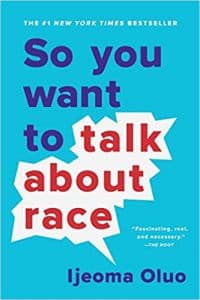 Equity is at the centre of competency-based pedagogy, and racism is one of our greatest obstacles to achieving equity. As we engage in the urgent process of deepening our anti-racist understanding and activity, Ijeoma Oluo'south book So You Want To Talk Nearly Race (Seal Press, 2018) offers powerful knowledge, insights, and guidance.
In the electric current moment, when the murders of Breonna Taylor, George Floyd, and then many other Blackness Americans accept been a tragic catalyst for increased attention to the need for fighting racism, the book is an essential resource. (It has recently been #1 on Amazon's lists ranging from African American Demographic Studies to Human being Resource & Personnel Management.)
Oluo explains the nuts, so probes the complexities. She respects the reader'due south positive intentions by making it clear that she aims to educate but refuses to sugarcoat painful truths. The book is not directly targeted to the pedagogy field but is securely relevant to education. Two chapters—"What is the schoolhouse-to-prison pipeline?" and "Why are our students and then angry?"—are about education explicitly.
The school-to-prison house pipeline chapter begins with the story of a Black student who, co-ordinate to a alphabetic character sent past the schoolhouse, had assaulted two teachers and used his mitt to mimic pointing a gun at other students. He was suspended, and a schoolhouse board fellow member suggested filing legal charges. The student, who had never been in trouble in school earlier, was five years old. He was having a developmentally normal burst that warranted empathy, redirection, and a multifariousness of less punitive responses.
Oluo cites statistics that Blackness students are suspended and arrested in schools at three to four times the rate of white students. She tackles head-on the question of whether this means that "there is something fundamentally incorrect with black and dark-brown people." Unequivocally, she reaches a unlike conclusion, that "the school system is marginalizing, criminalizing, and otherwise declining our black and brown kids in large numbers." The book highlights pervasive structural racism as a master driver of inequity in the United States, with individual racism—implicit and explicit—also playing a securely harmful role.
The author describes the school-to-prison house pipeline equally "the alarming number of blackness and brown children who are funneled straight and indirectly from our schools into our prison industrial complex, contributing to devastating levels of mass incarceration that lead to one in three black men and i in six Latino men going to prison in their lifetimes, in addition to increased incarceration for women of colour." Oluo discusses contributing factors including racial bias of administrators and educators, lack of cultural sensitivity, the pathologizing of Black children, zero-tolerance policies, and increased police presence in schools. The solutions she offers, with explanations and suggestions for each strategy, include confronting schools and school boards about disparate rates of discipline and opportunity, "normaliz[ing] black and brown childhood," discussing deeper causes of defiant behavior, and challenging the legitimacy of white-centered education.
The "Why are our students so angry?" chapter helps adults see how Black and Brown youth view the country's racism and other forms of oppression. Students have noticed that "no affair what individual progress we make, no matter how expert we strive to be, the organization remains" that enables unfair school funding, biased college admissions, and unjust law enforcement. Students encounter that "no matter how difficult they piece of work, and no matter what they accomplish, they could still be in the next viral video as they are gunned downward past a cop at a traffic stop."
With their justified anger, many students are becoming demoralized and disengaged from schoolhouse. Only Oluo notes that other students are becoming activists and independent thinkers, and her language echoes competency-based education's foundational principle of student agency. Describing a school walk-out and political protest march to city hall by hundreds of students from her son'southward schoolhouse, she shares some parents' reactions that students should have been "learning instead of protesting." Oluo disagrees, concluding that the students had been learning, and that was why they were protesting.
"Information technology is my job every bit a parent," she adds—and it seems that she's talking most educators also—"to help give them the platform they demand to build their way on, or to smash once they've decided it doesn't work for them. It is my job to keep them safety and back up them in the path they choose to take and provide whatever resources I tin to that finish." Information technology's our job to "trust that if nosotros would merely stop trying to control them and instead support them, they will eventually find their way."
Across the sections that are explicitly virtually educational activity, the book will assist educators and anyone seeking to deepen their anti-racist understanding and actions, particularly white people. With chapter titles such as "What if I talk virtually race wrong?," "Why am I e'er beingness told to 'check my privilege'?," "What is cultural appropriation?," and "Why can't I touch your pilus?," the writer packs a tremendous amount of noesis into a book I couldn't put downward. The concluding chapter—"Talking is great, but what else tin can I do?"—offers many ideas for concrete, anti-racist action in addition to those institute throughout the book.
1 of these calls to action closes the school-to-prison pipeline affiliate, where Oluo says that, to her, the biggest tragedy is non the long-term outcomes such equally poverty and joblessness. It is "the loss of childhood joy" and that "kids don't go to be kids." They don't get to be rambunctious or exuberant, considering those behaviors get them expelled or incarcerated. Her call to activity is "Do not wait until blackness and brown kids are grown into hurt and hardened adults to ask 'What happened? What tin nosotros do?' We cannot give back childhoods lost. Help united states of america save our children now."
Larn More
- Keeping Students at the Center with Culturally Relevant Operation Assessments
- Amplifying Messages on Disinterestedness and Anti-Racism from SXSW EDU
- Educolor: Elevating the Voices of Public School Advocates of Color
- What Practice You Hateful When Y'all Say "Student Agency"?
Eliot Levine is the Aurora Institute's Research Director and leads CompetencyWorks.
Follow @Eliot_Levine
Source: https://aurora-institute.org/cw_post/book-review-so-you-want-to-talk-about-race-by-ijeoma-oluo/
0 Response to "So You Want to Talk About Race Ijeoma Oluo Review"
Post a Comment